What Common Missteps Undermine Your Home Skincare Device Results?
Home skincare devices can make a consistent routine more convenient, but convenience does not guarantee better skin. Whether you use microcurrent tools, LED therapy masks, sonic facial cleansers, or other at-home facial devices, the outcome depends on more than simply turning a device on. Home skincare devices work through different mechanisms, have different limitations, and require different patterns of use. A routine that helps one person maintain comfortable, healthy-looking skin may produce little visible change for another.
The most common mistakes are often ordinary habits: using a device too frequently, skipping preparation, applying unsuitable products, expecting immediate transformation, or ignoring irritation because a routine promises long-term benefits. Understanding these errors can help you decide what is worth changing, what deserves more time, and when stopping is the safer option.
Key takeaway
Better results usually come from matching the device to a realistic goal, following its specific instructions, and monitoring your skin's response. More frequent use, stronger settings, and longer sessions are not reliable shortcuts. If a device causes persistent burning, swelling, blistering, or eye discomfort, stop using it rather than treating the reaction as part of the process.
1. Expecting Every Device to Solve the Same Skin Concern
One of the biggest mistakes is treating all home skincare devices as interchangeable beauty tools. Their underlying technologies differ, so their potential benefits and limitations differ too. A cleansing brush does not perform the same job as a microcurrent tool, and neither should be expected to deliver the same results as an LED mask.
Sonic facial cleansers use rapid mechanical movement to help loosen makeup, oil, and surface debris during cleansing. They may be useful for some people who prefer a device-assisted cleansing routine, but they do not replace a suitable cleanser or guarantee fewer breakouts. Excessive pressure, prolonged contact, or repeated cleansing can irritate the skin barrier.
Microcurrent tools deliver low-level electrical current through the skin using device-specific contact methods. Consumer products are often marketed for a temporarily lifted or more defined appearance. However, claims about lasting facial contour changes should be treated cautiously. Results can vary, and evidence for one device cannot automatically be applied to every product using the same general technology.
LED therapy masks use selected wavelengths of light for particular intended purposes. Red and near-infrared light devices are commonly marketed for skin appearance, while blue-light products may target acne-related concerns. The actual effect depends on factors such as wavelength, delivered dose, treatment schedule, device design, and the condition being addressed. A mask that looks similar to another may not deliver an equivalent treatment.
Other at-home facial devices, including tools that combine heat, vibration, or electrical stimulation, may have still different operating requirements. Before starting, identify the specific concern you want to address and check whether the device is intended for that purpose. If the main concern is persistent acne, unexplained pigmentation, a changing mole, or ongoing inflammation, a device may be an inappropriate substitute for professional assessment.
2. Ignoring What the Evidence Can Actually Support
Marketing language often makes a device sound more predictable than the available evidence justifies. Terms such as rejuvenating, sculpting, clearing, and rejuvenating light therapy can describe broad commercial promises without explaining the magnitude, duration, or certainty of an effect.
Evidence should be evaluated at the level of the specific technology and intended use. Research on a professional treatment does not establish that a less powerful home device produces the same outcome. Likewise, findings for one wavelength, electrical output, treatment duration, or study population may not apply to a different product.
It is also important to distinguish between a measurable biological effect and a meaningful cosmetic result. A device might produce a short-term change in skin appearance without demonstrating a lasting improvement in wrinkles, acne, or facial contours. A small study may suggest a possible benefit but still leave questions about long-term outcomes, adverse effects, and which users are most likely to benefit.
This does not mean every at-home skincare device is ineffective. It means the sensible question is narrower: does this particular device have credible evidence for the outcome I want, and is that outcome worth the time and effort required? If the evidence is limited, approach the device as an optional addition rather than a guaranteed solution.
Read claims carefully, look for research relevant to the actual product or its documented technical specifications, and be skeptical of dramatic before-and-after photographs without consistent lighting, comparable angles, or information about other treatments. Evidence-informed expectations help prevent disappointment and reduce the temptation to compensate for uncertain results by increasing treatment intensity.
3. Using Devices Too Often or for Too Long
When visible changes are slow, increasing treatment frequency can seem like a logical next step. Unfortunately, this approach can undermine results by adding irritation without establishing that the intended benefit will increase.
Different devices have different schedules. Some cleansing tools are designed for brief, regular use, while other devices specify a limited number of sessions each week. An LED mask may have a prescribed session length, and a microcurrent device may require particular contact conditions and a defined treatment pattern. These instructions are not interchangeable.
Overusing a sonic facial cleanser can contribute to tightness, redness, flaking, and increased sensitivity, particularly when it is combined with exfoliating acids, retinoids, scrubs, or other potentially irritating products. Excessive treatment can leave the skin uncomfortable even when each individual session initially seems harmless.
With microcurrent devices, using a higher setting or repeating passes beyond the instructions does not establish a better outcome. The same principle applies to LED therapy: extending a session beyond the manufacturer's directions is not a dependable way to increase the benefit.
Instead, use the prescribed schedule and change only one variable at a time when the instructions allow adjustments. If your skin becomes increasingly sensitive, pause the device and simplify your routine. If discomfort persists after stopping, seek appropriate medical advice rather than restarting to see whether your skin has adapted.
4. Skipping Preparation and Using the Wrong Products
Preparation is not a minor detail. It can affect device contact, comfort, hygiene, and the way a product is used.
For microcurrent tools, the required conductive gel or other approved contact medium is particularly important when specified by the manufacturer. Using the device on inadequately prepared skin can make movement uncomfortable and may interfere with proper contact. Ordinary moisturizer is not automatically an appropriate substitute for a product intended for electrical conduction.
For LED masks, follow the prescribed instructions about cleansing, wearing the device, and applying skincare products. Some routines call for clean, dry skin, while others may specify different preparation steps. Do not assume that a serum, sunscreen, facial oil, or active ingredient is compatible with every light-based device.
For sonic cleansers, use a cleanser appropriate for your skin and the device's instructions. Pressing harder, adding abrasive particles, or repeatedly passing over the same area can increase friction. A tool that feels effective because it produces a strong sensation is not necessarily cleaning more beneficially.
There is also a practical trade-off between combining multiple products and keeping a routine simple. Using several exfoliants while introducing a cleansing device can make it difficult to determine what caused irritation. If a new tool is being introduced, maintain a familiar, gentle routine and avoid adding several new active ingredients at the same time.
Clean reusable contact surfaces and attachments as directed, let them dry when required, and avoid sharing devices without appropriate cleaning and manufacturer approval. Residue, moisture, and poor storage can compromise hygiene and make an otherwise useful routine less comfortable.
5. Treating Irritation as Proof That a Device Is Working
A burning sensation, pronounced redness, or persistent tenderness should not be treated as evidence that a home skincare device is producing a stronger result. Cosmetic routines sometimes create mild, temporary sensations, but discomfort is not a reliable measure of effectiveness.
The appropriate response depends on the symptom and device. Mild pressure from a poorly positioned attachment may indicate that the technique needs to be corrected according to the instructions. Increasing pain, persistent warmth, swelling, blistering, or a rash requires a more cautious response. Stop using the device, discontinue potentially irritating products, and seek medical advice when symptoms are significant, worsening, or persistent.
LED devices deserve particular care around the eyes. Use only devices designed for the intended treatment area and follow their eye-protection requirements. Do not assume closed eyes alone provide sufficient protection. If treatment causes eye pain, changes in vision, or significant light sensitivity, discontinue use and obtain prompt medical evaluation.
Electrical stimulation devices may be unsuitable for certain people, including those with some implanted electronic medical devices or other conditions specified in the manufacturer's contraindications. Depending on the device, pregnancy, seizure disorders, or certain facial or skin conditions may also require avoidance or medical guidance. These restrictions vary by product and technology, so do not assume that clearance for one device applies to another.
Caution: Stop signs that should not be ignored
- Burning, pain, or redness that persists or worsens after treatment.
- Blisters, swelling, broken skin, or a new rash in the treated area.
- Eye pain, vision changes, or unusual light sensitivity during or after LED use.
- Increasing tenderness or irritation after repeated cleansing or electrical stimulation.
- Unexpected symptoms when using a device despite following its instructions.
Stop the treatment rather than increasing the setting or shortening the interval between sessions. Seek urgent medical attention for severe symptoms, significant eye symptoms, or signs of a serious allergic reaction.
6. Combining Too Many Treatments at Once
Adding several devices to a single routine may feel efficient, but it introduces more variables and can increase the cumulative burden on the skin. A sonic cleanser, exfoliating serum, retinoid, microcurrent tool, and LED mask each have their own instructions and potential limitations. Using all of them together does not automatically produce a better result.
The main problem is that effects and adverse reactions can overlap. If your skin becomes dry or inflamed after introducing three new products and two devices in the same week, it becomes difficult to identify the cause. You may then discontinue a useful product unnecessarily or continue using the actual trigger because the source of irritation is unclear.
A more informative approach is to establish a stable baseline routine and introduce one new device at a time. Follow its recommended schedule and observe how your skin responds before changing other parts of the routine. The observation period should be long enough to account for the device's intended use, but safety symptoms should never be ignored while waiting for results.
Be particularly careful when combining devices with prescription treatments, strong exfoliants, or products that increase sensitivity. A dermatologist or pharmacist can help assess specific combinations when the answer is not clear from the instructions. If a device is not explicitly designed to be used with another treatment, do not assume simultaneous use is safe.
7. Comparing Results Too Soon or Measuring the Wrong Thing
Unrealistic timelines are another common source of poor decisions. Some effects may be temporary, some intended outcomes require repeated use, and some advertised benefits may not be supported by strong evidence at all.
A microcurrent tool may be promoted for an immediate refreshed or lifted appearance, but a short-lived visual change does not establish a permanent structural effect. Similarly, an LED mask should not be judged solely by whether skin looks different immediately after one session if its intended protocol involves repeated treatments. A sonic cleanser may help remove surface debris, but it should not be expected to resolve every cause of acne.
Lighting, facial expression, hydration, makeup, camera distance, and time of day can all influence the appearance of skin in photographs. Before-and-after comparisons taken under different conditions may create an impression of progress or decline that does not reflect a meaningful change.
Choose one realistic outcome to monitor, such as whether cleansing feels comfortable, whether a particular cosmetic concern appears to change over time, or whether the routine is sustainable without irritation. Use consistent conditions when comparing photographs, and avoid interpreting small daily fluctuations as proof that a treatment is succeeding or failing.
Set a review point that reflects the manufacturer's recommended protocol and the type of outcome being assessed. If there is no meaningful improvement after an appropriate, consistently followed period, reconsider whether the device is suitable for the concern. Do not keep extending sessions indefinitely simply because the product has not met an ambitious marketing promise.
8. A Practical Comparison of Common Device Mistakes
The table below connects frequent errors with the mechanisms that matter and a more useful response. It is intended as general guidance rather than a universal treatment schedule, because device specifications and individual skin needs differ.
9. A Self-Check Before Your Next Session
Before using a home skincare device, run through this checklist. It can help distinguish a routine that is ready to continue from one that needs adjustment or a complete pause.
- ☐ Purpose: I can identify the specific concern the device is intended to address.
- ☐ Evidence: I understand the difference between a possible cosmetic benefit and a proven, lasting result.
- ☐ Instructions: I know the appropriate setting, session length, frequency, and required contact products.
- ☐ Skin condition: My skin is not showing unexplained irritation, broken skin, or an active reaction that makes treatment inappropriate.
- ☐ Compatibility: I have checked relevant contraindications and potential interactions with medications, skincare products, and other devices.
- ☐ Hygiene: The device and its attachments are clean and in suitable condition for use.
- ☐ Safety: I understand any required eye protection and know which symptoms mean I should stop.
- ☐ Expectations: I have a realistic goal and will not increase the intensity just because progress seems slow.
- ☐ Consistency: I can follow the recommended schedule without adding unnecessary treatments or repeatedly changing my routine.
If you cannot confidently check an item, resolve that uncertainty before proceeding. A skipped session is generally a better decision than improvising with an unfamiliar setting or continuing despite a warning sign.
10. Decide Whether to Continue, Adjust, or Stop
The most useful self-assessment is not simply whether a device seems to be working. It is whether the expected benefit, actual response, safety considerations, and effort required justify continuing.
Continue cautiously if the device is appropriate for your goal, you have no contraindications or warning symptoms, and you are following the instructions consistently. Keep the routine stable long enough to assess the intended outcome without chasing daily changes.
Adjust the routine if your skin is becoming mildly dry or uncomfortable, you are combining several potentially irritating treatments, or the technique is inconsistent with the instructions. Pause the suspected aggravating step, return to gentle basic skincare, and review the device guidance. Restart only when it is appropriate and symptoms have resolved; do not restart if the instructions or a clinician advise against it.
Stop and seek advice if you experience persistent or worsening irritation, pain, swelling, blistering, eye symptoms, or another unexpected reaction. Professional assessment is also appropriate when a skin concern persists despite reasonable care, worsens, or may need diagnosis rather than cosmetic treatment.
Reconsider the device if you have completed an appropriate course of use without a meaningful change in your chosen goal. If the available evidence is weak, the routine is burdensome, or the device cannot safely address your concern, discontinuing it may be more rational than buying additional attachments or trying a more aggressive setting.
People with highly reactive skin, certain medical conditions, implanted electronic devices, or medication-related photosensitivity may need additional guidance before using specific technologies. The right decision depends on the product and the individual, not a blanket rule that every home device is safe or unsafe for everyone.
Frequently Asked Questions
How long does it take to see results from home skincare devices?
There is no single timeline for all devices. Some advertised effects may be temporary, while other intended outcomes depend on repeated use over a prescribed period. The technology, product specifications, concern being addressed, and individual response all matter. Follow the manufacturer's protocol and evaluate the outcome realistically rather than expecting every device to produce immediate, lasting changes.
Can I use a microcurrent tool and an LED mask on the same day?
Possibly, but compatibility should not be assumed. Check both manufacturers' instructions, including contraindications, skin-preparation requirements, and whether sequential use is appropriate. If you are new to either device, introducing them separately makes it easier to identify the cause of irritation. Ask a qualified healthcare professional when your medical history or medication use raises a safety question.
Should my skin tingle or turn red after using a facial device?
A sensation or temporary change in appearance depends on the device and the circumstances, and it is not a reliable measure of effectiveness. Burning, significant pain, persistent redness, swelling, blistering, or worsening discomfort should prompt you to stop. Consult a healthcare professional if symptoms are severe, continue, or recur.
Can sonic facial cleansers make acne worse?
They can contribute to irritation when used too aggressively or combined with other harsh treatments. However, acne has several possible causes, so a cleansing device is not necessarily responsible for every breakout. Use a gentle cleansing routine, avoid excessive friction, and seek professional advice for persistent, painful, or scarring acne.
Is a stronger setting always more effective?
No. Device settings are not interchangeable measures of treatment quality. A stronger setting may increase discomfort or risk without providing additional benefit. Use only the settings permitted by the instructions, and never increase intensity to compensate for uncertain results.
What should I do if a device stops producing visible results?
First, check whether you are following the recommended schedule and whether the original goal is realistic for that technology. Consider changes in other skincare products, environmental conditions, and the consistency of your routine. If the expected benefit remains absent after an appropriate trial, reassess whether the device is suitable. Do not extend sessions or exceed the recommended frequency without a clear, evidence-based reason.
Are home skincare devices suitable for sensitive skin?
Not always. Suitability depends on the device, the reason for skin sensitivity, the person's medical history, and the specific instructions. A cleansing device may aggravate an already irritated skin barrier, and some light-based or electrical devices have individual precautions. If your skin is actively inflamed or reacts easily, prioritize gentle basic care and obtain professional guidance before introducing a new device.
Can a home device replace sunscreen or a regular skincare routine?
No. A device should not be treated as a substitute for fundamental skin care. Gentle cleansing, appropriate moisturization, and broad-spectrum sunscreen when indicated remain important parts of a routine. A device may be an optional addition for a specific purpose, but it does not eliminate the need to protect the skin or address persistent medical concerns appropriately.
Conclusion: Better Decisions Matter More Than More Devices
When home skincare devices fail to meet expectations, the cause is not always a defective product or a lack of effort. Sometimes the goal is poorly matched to the technology; sometimes the routine is too aggressive, preparation is inadequate, or the evidence does not support the promised outcome. In other cases, normal variation in skin appearance makes progress difficult to judge.
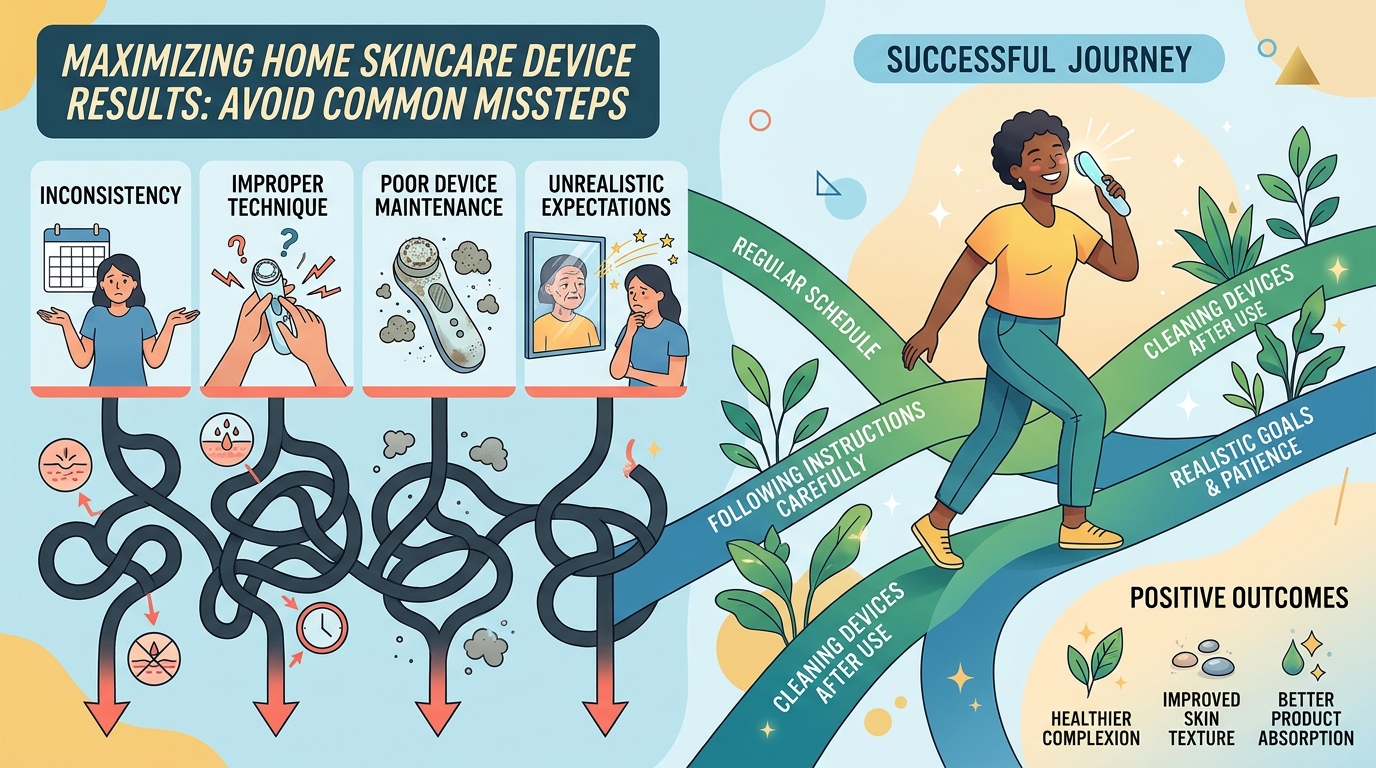
The practical response is to connect each decision to a clear reason. Choose a device only when its intended purpose matches your concern. Follow the specified treatment schedule instead of assuming that longer or stronger sessions will help. Introduce changes gradually, maintain clean equipment, and assess results under reasonably consistent conditions. Most importantly, treat warning symptoms as a reason to pause rather than a challenge to overcome.
There are situations in which continuing makes sense, situations in which a gentler routine is preferable, and situations in which professional advice should come first. If a device is comfortable, appropriate, and producing a realistic benefit, it may earn a place in your routine. If the benefit remains uncertain or the risks and effort outweigh the value, choosing not to use it is a reasonable outcome.
Effective at-home skincare is not measured by how many gadgets appear on the bathroom counter. It is measured by whether the routine is safe, manageable, evidence-informed, and suited to the person using it. That standard provides a more dependable path toward healthier-looking skin than chasing every new setting, trend, or promise.


Comments
Post a Comment